What’s in this guide:
- What a content marketing plan actually is (and what it isn’t)
- 6 steps to build one from scratch, even if you are solo
- A free downloadable template you can use today
- Common mistakes that waste months of effort: A self-check to see if your current plan is working
Most businesses don’t fail at content marketing because they run out of ideas. They fail because they have no system.
One month they write 4 blog posts. Next month they get busy and post nothing. Then they try Instagram for a bit. Then they forget about the email list they started. The result: scattered effort, no compounding, no results.
97% of marketers had a content strategy in 2026, and 61% said it significantly improved their ROI, per Taboola’s 2026 statistics report. The 3% without a strategy? Probably wondering why their content isn’t working.
A content marketing plan fixes this. It’s the difference between publishing randomly and publishing with a clear purpose. To speed things up, use our free Content Calendar Generator to lay out your posting schedule and the Content Pillar & Cluster Topic Generator to map your topics before you write a single post.
Source: Taboola Content Marketing Statistics 2026
What a content marketing plan actually is
Simple version: it’s a written document that answers 4 questions.
- Who are you creating content for?
- What will you create and in what format?
- Where will you publish it and how often?
- How will you know if it’s working?
That’s it. A content marketing plan is not a 40-page strategy deck. For a solo blogger or small business owner, it can fit in a Google Sheet or a Notion page.
A content strategy sets direction: why content exists, who it’s for, and how it supports your business goals.
A content marketing plan handles execution: what gets created, when it’s published, and how you track it.
You need both. Start with the plan.
Why writing it down important
25% of small businesses plan to invest in content marketing in 2026, per LocaliQ’s 2026 Small Business Marketing Trends Report. The ones who see results are the ones with a documented system. The ones who don’t are the ones winging it.
Galindo-Media’s 2026 analysis found that a small service provider publishing one well-researched article per week via a simple content plan saw steady traffic growth without any paid ads. Consistency, not volume.
You don’t need to post every day. You need to post on a schedule your audience can predict.
Sorces: LocaliQ Small Business Marketing Trends Report 2026
6 steps to build your content marketing plan
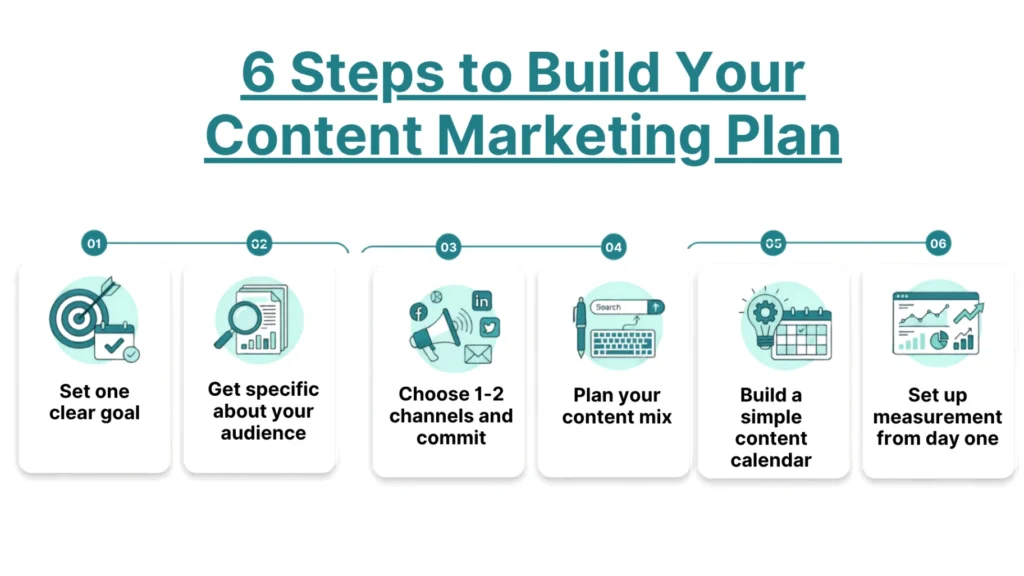
Step 1: Set one clear goal for 90 days
Most content plans fail at this step because they try to do too much. ‘Get more followers, rank on Google, grow email list, build brand awareness’ is not a goal. It’s a wish list.
Pick one goal for the next 90 days. Just one.
| Your goal | What your content should do |
| Get Google traffic | SEO-focused blog posts targeting specific keywords |
| Sell more to existing customers | WhatsApp broadcasts and email newsletters |
| Land freelance clients | LinkedIn posts and portfolio case studies |
| Build a blog audience | Consistent publishing with internal linking strategy |
| Drive local walk-ins | Google Business Profile + local keyword blog posts |
Goals also need a number. ‘Get more traffic’ is vague. ‘500 monthly organic visitors by month 3’ is a goal.
Smart goals work here: Specific, Measurable, Achievable, Relevant, Time-bound. Not because the acronym is fancy, but because vague goals produce vague results.
Step 2: Get specific about your audience
You need to know 3 things about your reader.
- What problem are they trying to solve when they find your content?
- What words do they use to describe that problem?
- Where do they already spend time online?
The words matter most. If your ideal customer Googles ‘meri website Google pe kyun nahi aati,’ that phrase tells you more about what to write than any keyword tool. Use their language, not your industry’s jargon.
For solo bloggers: Think about who you actually want reading your content 6 months from now. Not everyone. A specific person with a specific problem you can genuinely help with.
Step 3: Choose 1-2 channels and commit
Trying to be everywhere at once produces mediocre content everywhere. Pick the channels where your audience actually is.
| Business Type | Start Here |
| Food, beauty, fashion, retail | Instagram + WhatsApp |
| Healthcare, legal, finance | Blog (Google SEO) + WhatsApp |
| Freelancer, consultant | LinkedIn + personal blog |
| Solo blogger | Blog + one social channel |
| B2B, SaaS, manufacturing | LinkedIn + YouTube |
| Local Tier-2/3 city business | WhatsApp + regional language blog |
Add a second channel only after you have been consistent on the first one for 60 days. Not before.
Step 4: Plan your content mix
Your audience is at different stages before they buy from you. Some are just discovering you. Some are comparing options. Some are ready to act. Your content should address all 3 stages.
| Stage | What they need | Content type |
| Awareness | Answer to a question they already had | Blog post, how-to Reel, explainer video |
| Consideration | Proof that your approach works | Case study, testimonial, comparison post |
| Decision | Easy way to take the next step | Clear CTA, pricing info, booking link |
A practical weekly mix that works for solo operators: 3 posts that teach or inform, 2 that invite engagement (a question, a poll), 1 that promotes your product or service directly.
That ratio keeps your audience from feeling marketed to constantly, and it signals to algorithms that your content provides real value.
Step 5: Build a simple content calendar
Your content calendar doesn’t need to be fancy. A Google Sheet works. Notion works. Even a paper notebook works, as long as you actually use it.
What to track in your calendar:
- Topic or post title
- Target keyword (for blog posts)
- Platform and format (blog, Reel, email, WhatsApp)
- Draft date and publish date
- Status (ideas, in progress, done, published)
>> Free content marketing calendar template
Download the TeerthaTech content calendar template.Pre-built in Google Sheets. Covers 12 weeks across blog, social, email, and WhatsApp.
Plan at least 60-90 days in advance. Planning quarterly instead of weekly reduces the mental overhead of deciding what to post and lets you build thematic consistency.
One practical tip: Batch-create content. Set aside 2-3 hours once a week to write, record, or design your content for the next 7-10 days. Scheduling tools like Buffer (free plan) handle the rest.
Step 6: Set up measurement from day one
You don’t need to obsess over numbers in month 1. But you do need to know where to look.
| What to measure | Where to check | Why it matters |
| Organic traffic and keywords | Google Search Console (free) | Shows what searches are finding you |
| Social media reach and saves | Platform-native analytics | Saves signal genuine usefulness |
| Email open and click rates | Mailchimp or Brevo dashboard | Shows if your list is engaged |
| WhatsApp response rate | WhatsApp Business stats | Direct indicator of message relevance |
| Blog time-on-page | Google Analytics 4 (free) | Long time = content is actually being read |
Review these at the end of every month. Two questions to ask: which content got the most saves, shares, or direct responses? Which pieces brought someone to my website or inbox?
Do more of what those answers point to. Cut or change the rest.
4 mistakes that waste months of effort
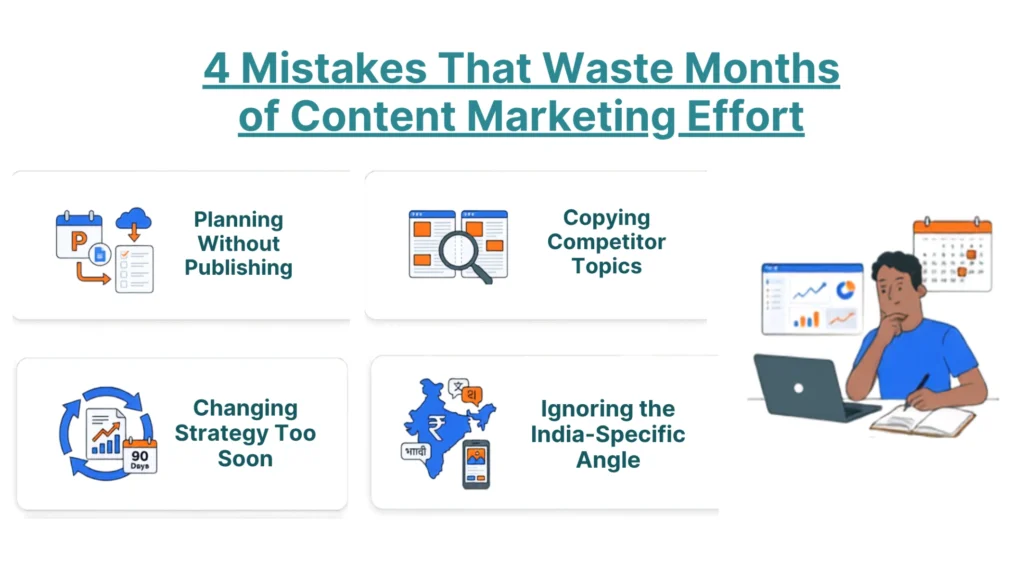
Mistake 1: Planning without publishing
Spent 3 weeks designing the perfect content calendar and then published nothing. It happens more than you’d think. A messy plan you actually execute beats a perfect plan sitting in a Google Doc.
Start publishing before your plan feels ‘ready.’ The plan improves once you have real data.
Mistake 2: Copying competitor content topics
Covering what your competitors cover means you are always behind them. Their content is already indexed, already ranked, and already has backlinks.
Find the gaps instead. What questions do your competitor’s posts leave unanswered? What India-specific angles do global blogs miss? What local context is entirely absent from the top 5 results?
That is where you build authority fast.
Mistake 3: Changing strategy every 6 weeks
41% of marketing teams now use sales impact to measure content success, per HubSpot 2026. But most small businesses give up before sales impact is even measurable.
Blog and SEO content takes 3-6 months to show traction. Social media takes 4-8 weeks of consistent posting. WhatsApp can show results immediately, but only if your list is already warm.
Pick a strategy. Run it for 90 days minimum before deciding if it’s working.
Source: HubSpot State of Marketing Report 2026
Mistake 4: Ignoring the India-specific angle
Most content marketing guides are written for US or UK audiences. That’s a gap you can exploit.
A blog post titled ‘best content marketing tools under Rs 2,000/month India’ will rank faster and convert better than one titled ‘affordable content marketing tools’ with dollar pricing.
INR pricing, Indian brand examples, regional language content, WhatsApp-specific strategies, Tier-2 city context: all of this differentiates you from the generic global content that dominates most search results.
If you know about Why Content Marketing is Important Learn Here
The bare-minimum content plan (fill this in)
| My content marketing plan (90-day version) Goal: [one specific, measurable goal] Audience: [who they are and what problem they’re solving] Primary channel: [where I’ll publish first] Content mix: [3 informational, 2 engagement, 1 promotional per week] Publishing schedule: [day and time] Primary keyword focus: [top 3 keywords I’m targeting this quarter] How I’ll measure success: [which metric, checked when] 90-day checkpoint date: [date] |
Fill that in. Print it. Put it somewhere you see it. That’s your content marketing plan.
You can build it into a full content calendar once you have this foundation. The template download above gives you the full version with 12 weeks of planning slots.
Our Final Thoughts
The single most common content marketing mistake is jumping straight into creating without a plan. You write a few posts, post them, see mixed results, and give up.
Write down your 90-day goal today. Pick your channel. Set a publishing schedule. That is the whole foundation.
Once that’s done, the actual content creation gets easier because you know exactly what you are making and why.
If you want to understand why content marketing is worth the effort before building your plan, our guide on why content marketing is important covers that with data. And once your plan is running, a free scheduler like Ahrefs Social Media Manager helps you stay consistent and track what’s working.
Our Sources
- Taboola Content Marketing Statistics 2026
- LocaliQ Small Business Marketing Trends Report 2026
- HubSpot State of Marketing Report 2026
- DemandSage Content Marketing Statistics 2026
- Shopify Marketing Plan Template 2026 (B2C 49% increasing spend)
FAQs
How long should a content marketing plan be?
As short as it needs to be and no longer. For a solo blogger or small business owner, a 1-2 page document covering your goal, audience, channels, content mix, schedule, and measurement is enough. The point of the plan is to guide decisions, not to impress anyone. A plan you actually follow in one page beats a 20-page document you never look at.
How far in advance should I plan content?
60-90 days is the practical sweet spot for small businesses, per Galindo-Media’s 2026 planning guide. Planning weekly is reactive and exhausting. Planning yearly is too rigid. Quarter by quarter gives you enough structure to be consistent and enough flexibility to respond to what’s actually working. Review and update monthly.
What is the difference between a content plan and a content strategy?
A content strategy is the bigger picture: why you are creating content, who it is for, and how it connects to your business goals. A content marketing plan is the execution layer: what gets created, when it gets published, who’s responsible, and how you’ll measure it. You need the strategy first to set direction. The plan handles the day-to-day. For solo operators, both can live in the same document.
Do I need expensive tools to run a content plan?
No. Google Sheets or Notion (free) for the calendar, Canva free for graphics, Buffer free for scheduling 10 posts across 3 platforms, and Google Search Console for keyword tracking. That’s a complete free stack. The only thing that costs money is your time. Once content marketing is generating real results, investing in SE Ranking (from Rs 1,200/month) for keyword tracking or Canva Pro (around Rs 330/month) for design makes sense. Not before.
How do I know if my content plan is working?
At 30 days: Are you publishing on the schedule you set? Consistency is the first metric.
At 60 days: Is organic traffic moving in Search Console? Are you getting direct messages or inquiries from your content?
At 90 days: Which posts have the most saves or shares? Which keywords are you appearing for, even if not ranking yet? These patterns tell you what is working before the results fully materialize. Adjust based on data, not on how you feel about the content.

Unnati is a content writer and researcher based in Gwalior, Madhya Pradesh (India). She is the founder and sole creator of TeerthaTech, where she researches and publishes informational content on content marketing tools and strategies for Indian small business owners, bloggers, and freelancers. While not a certified marketing professional, her work focuses on honest research, clear explanations, and transparent content practices to help readers make smarter decisions about the tools they use.