Quick Summary about post
- Content marketing generates 3x more leads than outbound marketing at 62% less cost.
- 76% of marketers say it generates demand and leads. 81% say it builds brand awareness.
- It keeps working after you stop paying. Paid ads don’t. These 8 reasons explain why, with sources you can verify.
So why is content marketing important? You have heard it a hundred times. ‘Start doing content marketing‘. Cool. But nobody explains why it is actually important, or whether it’s worth the effort when you are running a business solo.
So let’s skip the cheerleading and look at the data.
Content marketing generates more than 3 times as many leads as outbound marketing at 62% less cost. That’s from Demand Metric’s research, cited in DemandSage’s 2026 statistics report. The global content marketing industry is expected to hit $107.5 billion by 2026, according to Digital Silk. Neither of those things happens because marketers are irrational.
Here are 8 specific reasons it matters, with the evidence behind each one. Once you’re convinced, put it into action with our free Content Calendar Generator to plan your posting schedule, or the Content Pillar & Cluster Topic Generator to map out your topics.
1. It brings in leads without a paid ad budget
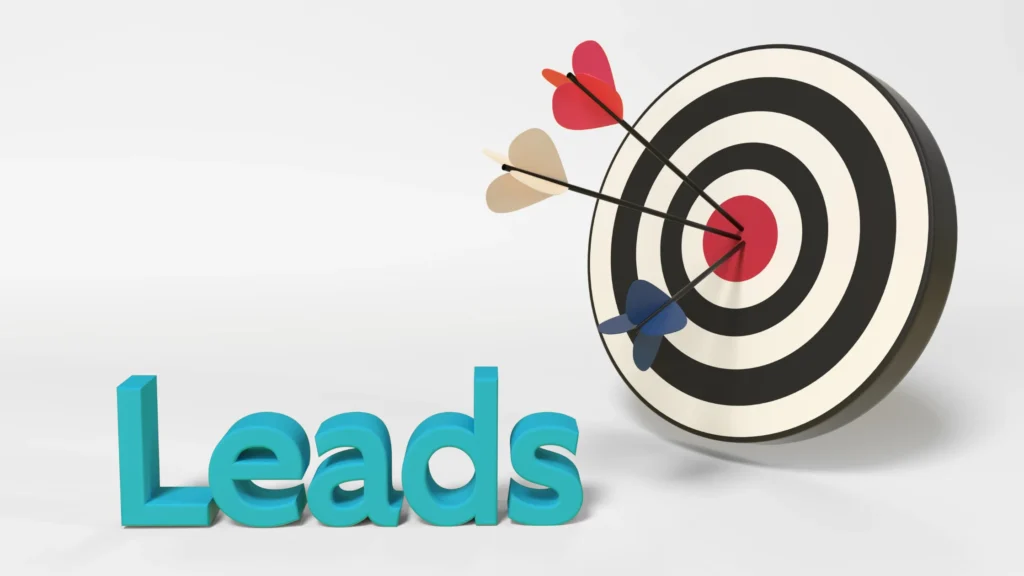
You can’t run a Rs 50,000-a-month Google ad campaign every month indefinitely. Most small businesses can’t. But you can write one well-researched blog post this week that keeps bringing visitors for the next 2 years.
76% of marketers say content marketing generates demand and leads, a 9% increase year-over-year, per DemandSage’s 2026 report. The trend is moving in one direction.
A paid ad stops the moment you stop paying. A blog post doesn’t.
2. It builds trust before anyone contacts you

Think about the last thing you bought that you’d never heard of. You probably Googled it, read a few articles, watched a video, checked reviews. By the time you clicked ‘buy,’ you already trusted it.
Content marketing is what builds that trust. When your blog post or Reel answers a question your potential customer was already asking, you’ve helped them before asking for anything.
81% of marketers say content marketing built brand awareness for them. 63% say it helped build loyalty with existing customers, per DemandSage’s 2026 analysis of CMI data.
For a freelancer trying to land better clients, that trust is often the entire reason a client picks you over someone cheaper.
3. It makes your website visible on Google

Every blog post you publish is one more page Google can show when someone searches for something related to your business.
Websites with a blog have 434% more indexed pages than sites without one, per DemandSage. More indexed pages means more keywords you can rank for, which means more people finding you for free.
Over half of all website traffic globally comes from organic search (Ahrefs). For an Indian small business targeting local customers in a specific city, this compounds fast because local search terms have far less competition than national ones.
A clinic in Nagpur ranking for ‘best general physician in Nagpur’ will rank faster than one targeting ‘best doctor in India.’ The same principle applies to every local business.
Source: DemandSage Content Marketing Statistics 2026
GrowthNavigate 2026
4. It delivers actual financial returns

Content marketing gets talked about as a brand-building tool. It also makes money.
Average ROI for content marketing in 2025: $7.65 for every $1 spent, per SQ Magazine’s analysis cited in Taboola’s 2026 report. Email marketing, which is a form of content, averages $42 return per $1 spent.
Short-form video content in 2025 attributed $8,900 in direct sales per $1,000 spent on production, per the same source.
These vary by channel and consistency. Content marketing is a savings account, not a lottery. The longer you contribute consistently, the better the return gets.
5. AI tools have made it significantly faster (and most people haven’t caught up)

68% of companies reported better content marketing ROI after using AI tools, per Digital Silk’s 2025 research. 94% of marketers plan to use AI in content creation in 2026, per HubSpot’s State of Marketing Report.
For a solo blogger or freelancer, this is genuinely useful. AI writing tools can get you from blank page to first draft in 20 minutes instead of 2 hours. You still need to edit, add your own experience, and make it specific. But the barrier to producing consistent content has dropped significantly.
Free options: ChatGPT, Google Gemini. Paid if you need more: Writesonic, Jasper.
Source: Digital Silk Content Marketing Statistics 2025
HubSpot State of Marketing Report 2026
| 68% of companies saw better ROI after adopting AI for content Source: Digital Silk, 2025 |
6. Old content keeps earning after you have moved on
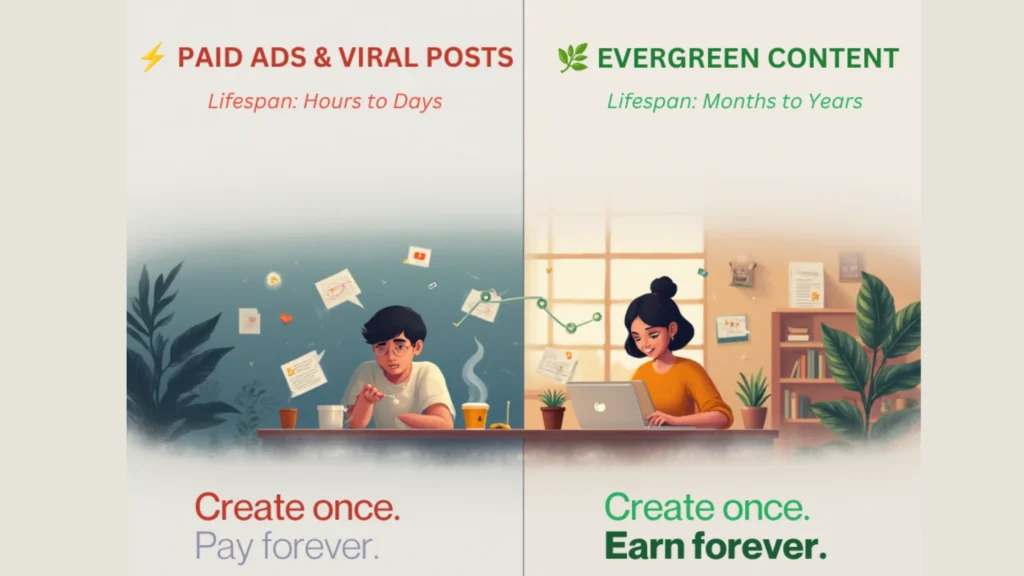
A paid ad runs for the days you’re paying. A social media post gets attention for 48 hours and disappears.
A well-written blog post that ranks on Google keeps bringing visitors for years. A YouTube video that answers a real question keeps getting found. An email subscriber you gained 6 months ago is still on your list.
54.5% of businesses plan to increase content marketing spend in 2026, per DemandSage. That is because the people doing it are seeing compounding returns, not because it is trendy.
Compounding is the key word. A business that published 2 posts a week for 2 years has 200+ pieces of content working for them. Each one is a door Google can send people through.
7. Most of your local competitors are doing it badly (or not at all)
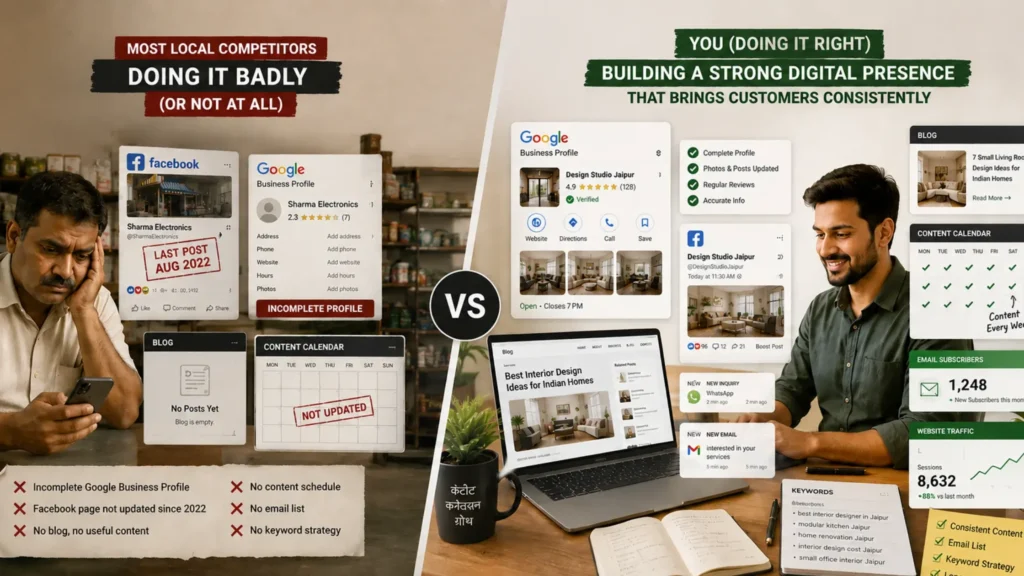
This is specific to small businesses in India and worth saying plainly.
Most local businesses have an incomplete Google Business Profile, a Facebook page that hasn’t been updated since 2022, and no blog. Very few have a consistent content schedule, an email list, or a proper keyword strategy.
Only 73% of B2B and 70% of B2C marketers have a documented content strategy, per Digital Applied’s 2026 analysis of CMI data. Meaning roughly 27-30% of businesses are doing content marketing without any real plan.
A business that shows up consistently with helpful, India-specific content in a specific city or niche builds topical authority faster than in any Western market, because the competition floor is lower. That window won’t stay open forever.
8. It builds an audience you actually own
Social media algorithms change. Instagram reach dropped significantly after Reels took over the feed. Facebook organic reach is a fraction of what it was in 2016. Platforms will keep changing, because that’s what platforms do.
A blog you own ranks on Google regardless of what Instagram decides. An email list you’ve built is yours. A WhatsApp broadcast list of 300 loyal customers is yours.
Email marketing delivers an average ROI of $42 per $1 spent, per Firework, cited in Siege Media’s 2026 statistics report. Email subscribers opted in. They’re not an algorithm-controlled audience.
Content marketing builds these owned assets. Social media posts build rented ones.
All 8 reasons in one place
| Reason | Core point | Key stats |
| Lead generation without ads | Content keeps working after you stop paying | 3x leads, 62% less cost (Demand Metric) |
| Builds trust early | Helps buyers trust you before they reach out | 81% marketers: builds brand awareness (CMI) |
| Google visibility | More content = more indexed pages | 434% more pages with a blog (DemandSage) |
| Real financial ROI | Avg $7.65 returned per $1 spent | $42 ROI for email per $1 (Firework) |
| AI makes it faster | 68% of companies saw better ROI with AI | 94% marketers using AI in 2026 (HubSpot) |
| Compounds over time | Old posts keep earning traffic and leads | 54.5% increasing CM spend (DemandSage) |
| Low local competition | Most Indian competitors have no real strategy | 27-30% doing CM with no plan (CMI) |
| Own your audience | Blog + email = assets you control | $42 ROI per $1 on email (Firework) |
What happens if you skip it
Skipping content marketing doesn’t mean nothing happens. It means some specific things happen instead.
- You stay invisible to people actively searching for what you offer. They find your competitor.
- You stay dependent on paid ads or word of mouth. Both require constant effort or money to sustain.
- You build no compounding asset. Every month you don’t publish is a month your competition gets further ahead.
- Your website stays thin in Google’s eyes. Thin sites rank poorly and lose to sites with consistent content.
None of this is catastrophic in week 1. Over 12 to 24 months, the gap becomes very visible.
A quick check: where are you right now?
| Answer these honestly : 1. Do you have 5+ published blog posts targeting specific keywords? 2. Do you post on at least 1 platform at least 3 times a week, every week? 3. Do you have an email list or WhatsApp list you contact regularly? 4. Have you checked Google Search Console in the last 30 days? 5. Do you have a written content plan for the next 30 days? >> 3 or more No answers means content marketing is your biggest growth opportunity right now. |
Now, where to start
One piece of content that answers one real question your audience asks. That’s the starting point.
If you want a step-by-step system for going from zero to consistent, our content marketing plan guide covers the process in full. And if you want to know which tools are worth using at each budget level, the content marketing tools guide has that covered.
Start this week, not next month.
Our Final Thought
Content marketing is important because decisions get made based on information people trust, and content is what builds that trust. That has been true for 10 years. It is still true.
What is changed is that AI has made it faster to produce, the tools are cheaper, and most Indian small businesses still haven’t built a consistent system. That’s the window.
If you’re ready to build one, the content marketing plan guide is the right next step.
Our Resources
- Demand Metric Lead Generation Study (3x leads, 62% less cost)
- DemandSage Content Marketing Statistics 2026 (76%, 81%, 63%, 434%, 54.5%)
- Digital Silk Content Marketing Statistics 2025 ($107.5B market)
- Digital Silk 2025 (68% better ROI with AI)
- Taboola Content Marketing Statistics 2026 ($7.65 ROI, $8,900 video, 97% have strategy)
- HubSpot State of Marketing Report 2026 (94% using AI)
- GrowthNavigate 2026 (Ahrefs organic traffic stat)
- Digital Applied 2026, citing CMI (73% B2B, 70% B2C documented strategy)
- Firework / Siege Media 2026 ($42 email ROI)
- SeoProfy 2025, citing Semrush (51% zero extra cost)
- Content Marketing Strategy India 2026 (regional language 3-5x reach)
FAQs
Is content marketing still relevant with AI changing everything?
More relevant. AI has flooded the internet with generic content, which means specific, experience-backed content from real people stands out more, not less. 97% of marketers had a content strategy in 2026, and 61% said it significantly improved their ROI, per Taboola’s 2026 report. The bar for mediocre content got lower. The bar for genuinely useful content got higher. That is good for anyone willing to meet it.
How long before I see results?
Social media: visible engagement growth within 4-8 weeks of consistent posting.
Blog and SEO: Google typically takes 3-6 months to rank new posts, faster for local and niche terms.
Email and WhatsApp can show results the same week because you are talking directly to people who already know you. Month 2 is when most people quit. That’s usually when the foundation is being laid.
Can I do this with zero budget?
Yes, Canva is free for graphics, Buffer is free for scheduling, Google Search Console is for keyword data, and WhatsApp Business is for direct broadcasts. 51% of small businesses say they have no extra costs from content marketing because they use free AI and design tools, per Semrush data cited in SeoProfy’s 2025 report. Time and consistency are the constraints, not money.
What type of content works best in India?
3 formats consistently deliver:
Blog posts targeting local keywords (long-term Google traffic),
short-form video on Reels or YouTube Shorts (fast visibility), and
WhatsApp broadcasts to existing customers (immediate results, no algorithm). Regional language content, Hindi, Tamil, Marathi, or whichever language your customers use, delivers 3-5x higher organic reach than English for local businesses.
What is the difference between content marketing and social media marketing?
Social media marketing is one channel. Content marketing is the broader system of creating useful content across your blog, email, WhatsApp, and everywhere else you publish, to build trust and drive business outcomes. Social media posts disappear into a feed. Blog posts rank on Google. Email lists are yours to keep. Social media is one piece of the system, not the whole thing.
Want to know more about content marketing?
Read the full guide here: What is Content Marketing? A Simple Guide for Indian Small Business Owners (2026)

Unnati is a content writer and researcher based in Gwalior, Madhya Pradesh (India). She is the founder and sole creator of TeerthaTech, where she researches and publishes informational content on content marketing tools and strategies for Indian small business owners, bloggers, and freelancers. While not a certified marketing professional, her work focuses on honest research, clear explanations, and transparent content practices to help readers make smarter decisions about the tools they use.