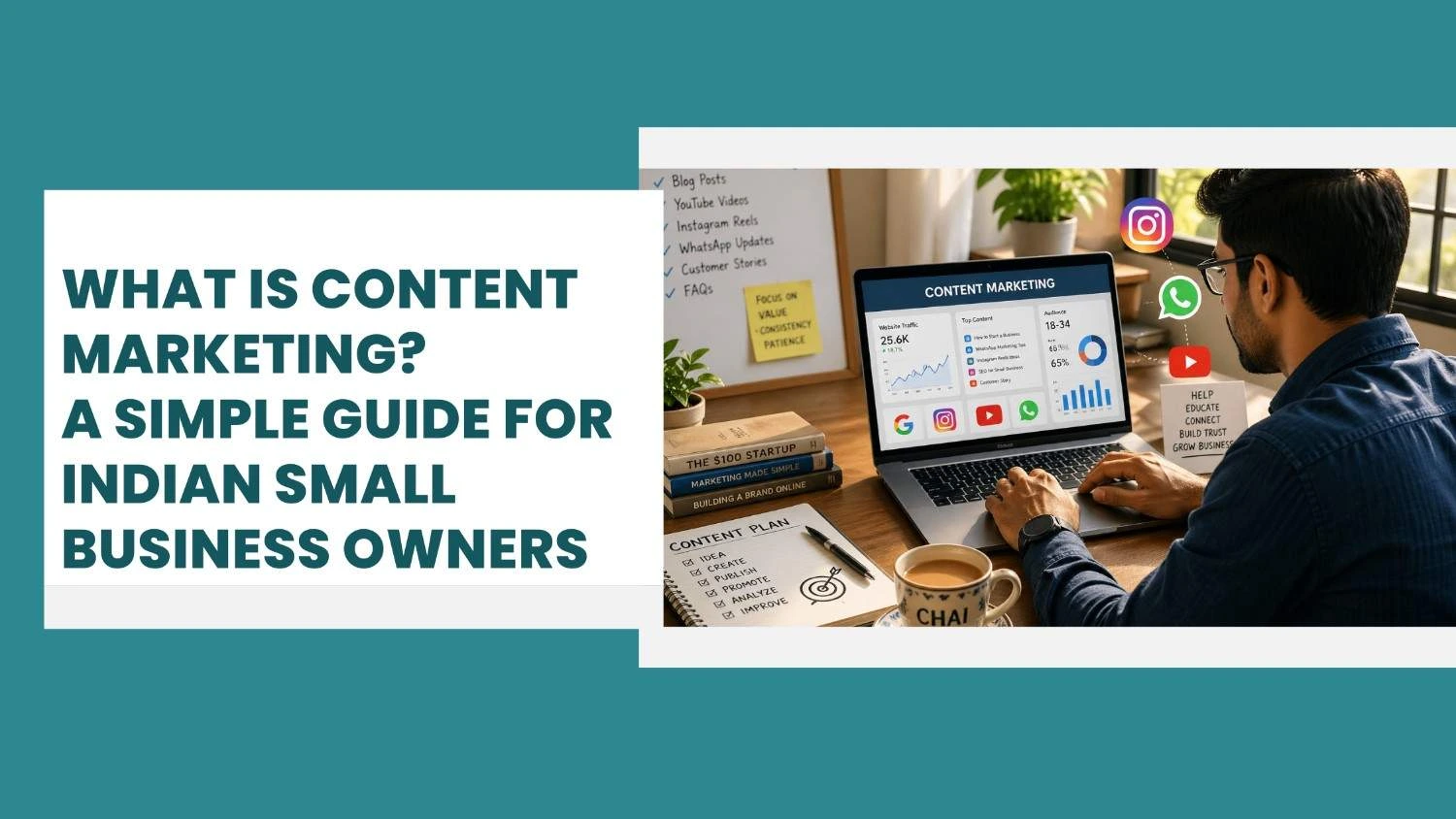
So what is content marketing for small business in India, really? Before we start, here is what this guide covers. What content marketing actually means in simple words. Why it work better than paid ads when you have a small budget? How real Indian brands have used it to grow, with actual numbers to back it up. What types of content work best in India, including WhatsApp which most guides completely skip. A clear INR budget breakdown so you know exactly what to spend and when. And a simple step-by-step process to start this week.
If you are a small business owner, a solopreneur, a freelancer, or someone who just wants to understand how to grow online without spending a lot of money, this is for you. To help you get started right away, try our free Content Calendar Generator and Content Pillar & Cluster Topic Generator – no signup required.
Let Me Start With Something That Happened to Me
When I first started learning content marketing, I really struggled to find clear and practical guidance. This journey inspired me to share my learnings in simple language, especially for small businesses without a tech background. I want readers here to find clarity and confidently start their own content marketing journey.
I remember seeing a post about hair care on Instagram once, and I genuinely thought the content was great. Curious, I went to their website, checked reviews, and slowly began to trust them. Finally, I bought their product, then I realized that was actually the power of content marketing, influencing decisions without ever making it feel forced.
That experience was the first time I realized that content marketing is not some complicated corporate strategy. It is just a business being genuinely helpful or interesting online, and people responding to that.
So, What is Content Marketing, Really?
Content marketing is when a business creates useful, helpful, or interesting things online, like articles, videos, posts, or messages, so that people naturally discover the business, start to trust it, and eventually buy from it.
That is the whole idea. Nothing more complicated than that.
The word “content” just means anything you create and put online. A blog post is content. An Instagram Reel is content. A WhatsApp message with useful information is content. A YouTube video showing how something works is content.
The word “marketing” just means reaching the right people. When you combine the two, you are reaching the right people by giving them something they actually want to see or read.
How is This Different From Normal Advertising?
Most of us have grown up seeing traditional advertising. A newspaper ad, a TV commercial, a pamphlet in your mailbox. These work by interrupting you. You were watching a show, and suddenly there is an ad. You were reading an article, and a banner appeared.
Content marketing works the other way around. Instead of interrupting people, you create something they actually want to find. A recipe video they searched for. A blog post answering their question. A helpful WhatsApp update they signed up for.
The difference matters enormously when you have a small budget.
| Factor | Traditional Advertising | Content Marketing |
|---|---|---|
| What it costs to start | Usually Rs 5,000 to Rs 50,000 per campaign | Can start at Rs 0 |
| How it finds people | Interrupts them | They find you |
| What happens when you stop | Results stop immediately | Old content keeps working |
| Trust it builds | Low, because people ignore ads | High, because it helps people |
| Best for | Fast reach if you have money | Long-term growth on a small budget |
Why This Is Needed Especially for Indian Small Businesses Right Now
Let me share some real numbers about India’s digital situation in 2026, because they explain exactly why content marketing works so well here right now.
India has over 1.03 billion internet users today. WhatsApp alone has more than 500 million active users in India, which is the largest WhatsApp user base of any country in the world. The average Indian Internet user spends about 6 to 7 hours online every day across different apps and websites.
What this means for your business is simple. Your customers are already online, already searching, already scrolling. The question is just whether they are finding you or someone else when they look.
And here is the thing about small businesses specifically. You cannot out-spend bigger competitors on ads. A large company can spend lakhs every month on Google ads and Instagram promotions. You probably cannot, and should not try to. But you absolutely can out-help them, out-inform them, and out-connect with local customers in ways a big company never can. That is the entire advantage of content marketing for small business in India.
Real Indian Examples With Actual Numbers
I want to be upfront here. A lot of content marketing guides use vague made-up examples. I am going to use real brands with real data that you can look up yourself.
Zomato: How Funny Posts Built a Brand Worth Thousands of Crores
Zomato started as a restaurant discovery website in 2008. Today it has over 80 million monthly active users and more than 300,000 restaurant partners across India.
A big part of how they grew is not through paid advertising. It is through content. Zomato gets over 30 million monthly organic visits, which means people find Zomato through Google searches without Zomato paying for a single click. Over 53% of their website traffic comes from organic search, which means more than half their visitors find them through content, not ads.
On social media, their posts are short, funny, and relatable. During trending events, movies, or festivals, Zomato uses real-time marketing to post memes or witty lines that go viral. Their famous push notification messages like “Salads don’t ask silly questions. Burgers understand” are a form of content too, and push notifications like these can boost engagement by over 50% compared to boring messages.
Now you are not Zomato, and you do not need to be. The lesson here is not “do what Zomato does.” The lesson is that even at the largest scale, content consistently outperforms just spending money on ads.
Mamaearth: From Zero to Rs 1,920 Crore Using Education as Marketing
Mamaearth was started in 2016 by Varun and Ghazal Alagh after they could not find safe, toxin-free baby products in India. They had no celebrity backing, no big investment, and no offline stores when they started.
Their entire early growth strategy was based on content marketing. They educated people. They wrote about why certain chemicals in beauty products are harmful. They explained what parabens and sulfates actually do to skin. They taught new parents things that helped them make better decisions.
In just two years of starting, they crossed Rs 100 crore in revenue by focusing on digital-first sales and using customer feedback to launch new products. Over five years from FY20 to FY24, their revenue grew from Rs 114 crore to Rs 1,970 crore, which works out to a compound annual growth rate of over 100%.
They spent 90% of their marketing budget on digital platforms, and collaborated with over 500 mom bloggers to build trust among millennial parents.
The content marketing lesson from Mamaearth is this. They did not start by saying “buy our products.” They started by saying “here is important information that affects your family’s health.” Customers trusted them as educators first. The sales followed naturally.
This is exactly the approach that works for any small business. A doctor who explains common health questions. A CA who writes about tax saving tips. A fitness trainer who posts workout videos. An interior designer who shares decorating ideas. You educate first, you sell second.
What Types of Content Work Best in India
Blog Posts and Articles
A blog post lives on Google. When someone searches for something related to your business, a well-written post can show up at the top of the results and bring you that reader without you spending a single rupee on ads.
Blog posts work especially well for businesses where trust matters before someone buys. Healthcare, finance, legal services, education, consulting. These are areas where people research extensively before making a decision. If your content is the one they read during that research, you are already ahead.
Social Media Posts
Instagram, Facebook, and LinkedIn are where most Indian small businesses should start because the cost to begin is zero and the potential reach is enormous.
The most important thing about social media is not how many followers you have. It is how consistently you show up. A business that posts three times a week every single week will build more trust than one that posts thirty times in one week and then disappears for a month.
If you need a free social media manager tool to plan and schedule your content for social media posts?
Explore Our post related to this- A free social media management tool For content Marketing for sicoal media (Ahrefs SMM)
WhatsApp Marketing
This is the most underused content channel for Indian small businesses, and I want to spend some time on it because almost no guide talks about this properly.
WhatsApp gives you something Instagram and Facebook cannot. Direct access to your customers without any algorithm deciding whether your message gets seen. When you send a broadcast message to your customers on WhatsApp, they see it. There is no feed competing with it.
WhatsApp Business is completely free. It lets you set up a business profile, create a product catalog, save quick replies for common questions, and send broadcast messages to up to 256 contacts at once. For a local business with a regular customer base, this is genuinely powerful.
The key to WhatsApp content is that it should feel personal, not promotional. A daily specials message from a restaurant feels helpful. A “30% off today only” blast every morning starts to feel like spam. The difference is the same as getting a useful tip from a friend versus getting a sales call.
Short Videos (Reels and YouTube Shorts)
Video is the fastest-growing content format in India right now. The good news is that professional equipment is not required. Some of the most-watched Reels in India are recorded on basic Android phones.
What matters in video is not production quality. It is whether the first three seconds make someone stop scrolling. A genuine, unscripted moment of you doing your actual work, cooking something, fixing something, creating something, will almost always outperform a polished but hollow video.
Email Newsletters
Email is significantly underused by Indian small businesses, which creates a real opportunity. When someone gives you their email address, they are actively saying they want to hear from you. That is a much stronger relationship than a social media follower who may or may not see your posts.
Even a small, engaged email list of 200 to 300 people can drive meaningful results when used consistently.
How to Actually Start: Four Simple Steps
Step 1: Know Who You Are Talking To
Before writing anything or recording anything, get clear on who your actual customer is. Not a vague description, but a specific one.
The most practical way to do this is to think about your five best current customers. What do they have in common? What problem were they trying to solve when they first came to you? What language did they use to describe that problem?
This matters because the language your customers use to describe their problems is exactly the language you should use in your content. If they say “my back is killing me,” you write about back pain. You do not write about “lumbar spinal discomfort.”
Step 2: Pick One Platform
The biggest mistake small business owners make is trying to be on every platform at once. Instagram, Facebook, LinkedIn, YouTube, Pinterest, Twitter, all running simultaneously with no focus.
The result is usually mediocre presence everywhere and strong presence nowhere.
Pick the one platform where your specific customers spend the most time, and focus completely on that first. Here is a simple guide for common Indian business types.
If you run a food business, salon, retail shop, or anything where visuals matter, Instagram is your best starting point. If you serve other businesses or work in a professional field like finance or law or HR, LinkedIn will give you better quality leads. If you already have a loyal customer base and want to deepen that relationship, WhatsApp is your highest-return option. If you want long-term traffic from Google that keeps coming without you having to post every day, a blog is the best investment.
Step 3: Use a Simple Weekly Posting Pattern
Once you have your platform, you need a rhythm. The exact number of posts matters less than the consistency.
A pattern that works for most small businesses is what I call the 3-2-1 week. Three posts that teach or inform something genuinely useful to your audience. Two posts that invite conversation, a question, a poll, asking for their opinion. One post that directly mentions your product or service.
This ratio keeps your audience interested because most of what you share helps them, not just promotes to them.
Step 4: Pay Attention to What Actually Connects
After about a month of consistent posting, start looking at your numbers. Not just likes, but saves, shares, direct messages, and comments that go beyond just an emoji.
Which post got the most saves? Saves usually mean someone found it genuinely useful. Which post led to a direct message or a phone call? Those are the ones converting interest into action. Which topics got people tagging their friends?
The answers tell you what your specific audience values from you. Do more of that, less of everything else.
Content Marketing Budget for Indian Small Businesses: Real INR Numbers
This is information that almost no other blog provides properly. Here is what you actually need to spend at different stages.
Stage I : Rs 0 Per Month
You can absolutely run a real content marketing operation for free. I am not saying this to sound encouraging. The tools genuinely exist.
Canva’s free version gives you thousands of templates for social media posts, Stories, Reels covers, presentations, and more. Buffer’s free plan lets you schedule up to 10 posts across three different social profiles. Google Search Console shows you exactly which search terms are bringing people to your website. WhatsApp Business is free and has more features than most small businesses ever use. Google Business Profile is free and one of the most overlooked tools for local businesses in India.
With just these tools and a consistent schedule, you can build a real online presence before spending anything.
Stage II : Rs 1,000 to Rs 3,000 Per Month
Once you start seeing results and want to do more, a small monthly investment unlocks significantly more.
Canva Pro costs around Rs 330 per month on an annual plan and gives you a brand kit, advanced templates, background remover, and the ability to schedule posts directly. Brevo (which was previously called Sendinblue) has a free plan for email marketing up to 300 emails per day, and their paid plans start around Rs 700 per month. Buffer’s paid plan starts around Rs 400 per month and removes the post limit. Writesonic for AI-assisted writing starts around Rs 1,500 per month.
Stage III : Rs 5,000 to Rs 10,000 Per Month
At this level, you are adding SEO tools that help you find low-competition keywords, track your Google rankings, and understand what your competitors are doing online.
SE Ranking, which is a complete SEO tool, starts at around Rs 1,200 per month and is one of the better value options for Indian small businesses. Semrush, which is the industry standard, starts at around Rs 8,000 per month.
The honest advice is to start at zero, prove to yourself that you can be consistent, and only then invest money. Many businesses pay for expensive tools before they have even established a posting habit. The tool cannot create consistency for you.
Content Ideas for Different Types of Indian Businesses
Restaurants and Food Businesses
The content that works best for food businesses is anything that makes food look appealing or that creates a sense of occasion. Behind-the-scenes kitchen videos work extremely well because people are genuinely curious about how their favorite food is made.
A “what is fresh today” WhatsApp update sent every morning to your regular customers takes five minutes and keeps your business top of mind. A weekly post asking followers to guess a mystery ingredient in your recipe generates comments without any cost.
On Google, a blog with posts about local food culture, recipe tips, or guides to eating well on a budget in your city builds local search authority over time.
Salons and Beauty Businesses
Seasonal care content performs consistently well here. Topics like how to protect your hair during monsoon, summer skincare routines for Indian skin, or how to maintain a keratin treatment at home bring in readers who are exactly your target customers.
Before-and-after posts, always with the client’s consent, remain the highest-converting content type for salons because the visual proof is immediate.
WhatsApp is especially useful for re-engagement. A simple message to customers who have not visited in two or three months, mentioning their name and noting it has been a while, has a higher conversion rate than almost any social media post.
Clinics and Healthcare Providers
Educational content is the most powerful format for healthcare businesses because it builds trust before a patient ever walks through your door.
FAQ-style blog posts that answer common patient questions in plain language, not medical jargon, perform very well on Google. Seasonal health content distributed through WhatsApp, like dengue prevention tips during monsoon or winter immunity information, keeps your patients engaged between visits and positions your clinic as a trusted resource rather than just a place they go when something is wrong.
Retail Shops
New arrivals content posted consistently creates a habit in your followers of checking your profile for updates. The key is posting as soon as new stock arrives, not after it has been sitting on the shelf for a week.
Festive content planning is one area where most retail shops leave a lot of opportunity on the table. Creating content for Diwali, Holi, Eid, Navratri, and regional festivals four to six weeks in advance, rather than rushing a day before, makes a visible difference in engagement and sales during those periods.
Freelancers and Consultants
LinkedIn case studies are the most effective content type for anyone selling professional services. The format is simple. Here was the problem my client faced. Here is what I actually did. Here is the measurable result.
That kind of post demonstrates real competence far more convincingly than any credentials or self-promotional post ever will.
Common Mistakes That Hold Indian Small Businesses Back
- The most common mistake is posting only about your products and services. If every post is “buy this” or “book now” or “limited offer today,” people stop following you. Think about who you follow on social media and why. It is rarely because they advertise to you constantly.
- The second mistake is starting with high energy and then disappearing. A business that posts fifteen times in January and then goes quiet until March is actually hurting its credibility. Potential customers who find your profile and see a two-month gap in activity wonder if the business is even still open.
- The third mistake, and this one is very specific to Indian businesses, is ignoring the local angle. A clinic in Nagpur that writes “health tips for patients in Nagpur” will rank much more easily on Google than one that writes generic health content. Your specific city, neighborhood, or region is an asset in content marketing, not a limitation.
- The fourth mistake is quitting before results arrive. Content marketing has a compounding nature. The first three months feel slow. Month four and five, you start seeing patterns. By month six to twelve, if you have been consistent, the growth becomes visible. Almost everyone who gives up does so in month two or three, right before things start to work.
My Sources & Citations
- India 1.03B internet users — DataReportal 2026
- WhatsApp India 500M+ users — OurOwnBrand 2026
- Zomato 80M monthly active users — IIDE Case Study
- Zomato 71M organic traffic — Semrush, Nov 2025
- Zomato push notification 50% engagement boost — Eflot
- Mamaearth Rs 100Cr in 2 years — VigyapanMart
- Mamaearth 103.8% CAGR FY20–FY24 — OrangeOwl
- Mamaearth 90% digital budget + 500 bloggers — StartupTalky
- Mamaearth FY24 Rs 1,919 Cr revenue — Storyboard18
Frequently Asked Questions (FAQs)
What is content marketing in the simplest possible terms?
It means helping your potential customers by giving them useful information, entertaining content, or practical tips so that they see you as someone worth trusting. Instead of interrupting them with ads, you create things they actually want to find, and they come to you.
Does content marketing really work for a small shop or a one-person business?
Yes, and in some ways it works better for small businesses than for large ones. A neighborhood bakery can post about its actual daily routine and customers will feel a genuine connection. A large corporation trying to do the same thing often feels hollow and scripted. Your smallness and realness is an advantage, not a handicap.
How long does it take before I see any results?
For social media, you can usually see growing engagement within four to eight weeks if you are posting consistently. For blog content and Google rankings, three to six months is a realistic timeline. For WhatsApp, results can be immediate because you are sending directly to people who have already expressed interest in your business.
Do I need to hire someone to do this, or can I do it myself?
Many Indian small business owners manage their entire content presence by themselves, using only a smartphone and free tools. The key is choosing one or two platforms rather than trying to manage everything, and building a simple weekly routine rather than treating it as something special you do occasionally.
Which platform should I start with?
If your business has a strong visual element, like food, fashion, interiors, or beauty, start with Instagram. If you serve businesses or professionals, LinkedIn will give you better-quality leads. If you have existing customers you want to stay connected with, WhatsApp is the highest-return starting point. If you want people to find you through Google searches over the long term, start a blog.
My Final Thoughts
I started teerthatech.com because, when I first began learning content marketing, I honestly found it more confusing than helpful. The overly complex language and heavy concepts everywhere made me feel it was only for experts. After much trial and error, I decided to share the things I understood in a simple and practical manner.
I don’t claim to be a content marketing expert, and I’m still in the learning phase. But whatever I learn from practical experiments, real results, or mistakes. I share here simply and clearly. My goal is to understand and test things myself first, then pass on only what actually works to you, so you can start confidently and without confusion.
If there is one thing I want you to take away from this post, it is that content marketing is not complicated and it is not just for big companies. It is just the practice of being helpful to the people you want to serve and doing it regularly enough that they start to notice and trust you.
Start with what you already know. Your customers have real questions. Answer those questions honestly and clearly, in whatever format feels natural to you. That is the entire foundation.
If you want a free tool list or a ready-made content calendar to get started, I have put both together for you. Check the related posts below.

Unnati is a content writer and researcher based in Gwalior, Madhya Pradesh (India). She is the founder and sole creator of TeerthaTech, where she researches and publishes informational content on content marketing tools and strategies for Indian small business owners, bloggers, and freelancers. While not a certified marketing professional, her work focuses on honest research, clear explanations, and transparent content practices to help readers make smarter decisions about the tools they use.